
Nearly every complex chronic condition shares one thing in common: a nervous system stuck in a state of threat. Whether the original trigger was an infection, a concussion, mold exposure, or years of accumulated trauma, the body's alarm system can get locked on — flooding the system with stress signals long after the original event has passed. The autonomic nervous system, meant to cycle flexibly between activation and rest, instead freezes into a chronic fight, flight, or freeze pattern.
This is why nervous system regulation is not optional — it is foundational. Programs like Primal Trust, DNRS, and somatic experiencing work by teaching the brain that it is safe again, allowing the misfiring stress responses to quiet down so the body can finally heal. As Dr. Cathleen King, founder of Primal Trust, explains, when you regulate the nervous system, you shift the body out of threat physiology and into a state where healing is actually possible. For many patients, this work alone produces dramatic improvement.
Peter Levine, the developer of Somatic Experiencing, has spent decades demonstrating that trauma is not just a psychological story — it is held in the body as incomplete survival responses. His work shows that when the body is allowed to slowly discharge the trapped energy of a threat response, the nervous system can return to regulation. The key is not to relive the trauma, but to let the body complete what it never got to finish, in small, tolerable doses, while staying connected to the present moment.
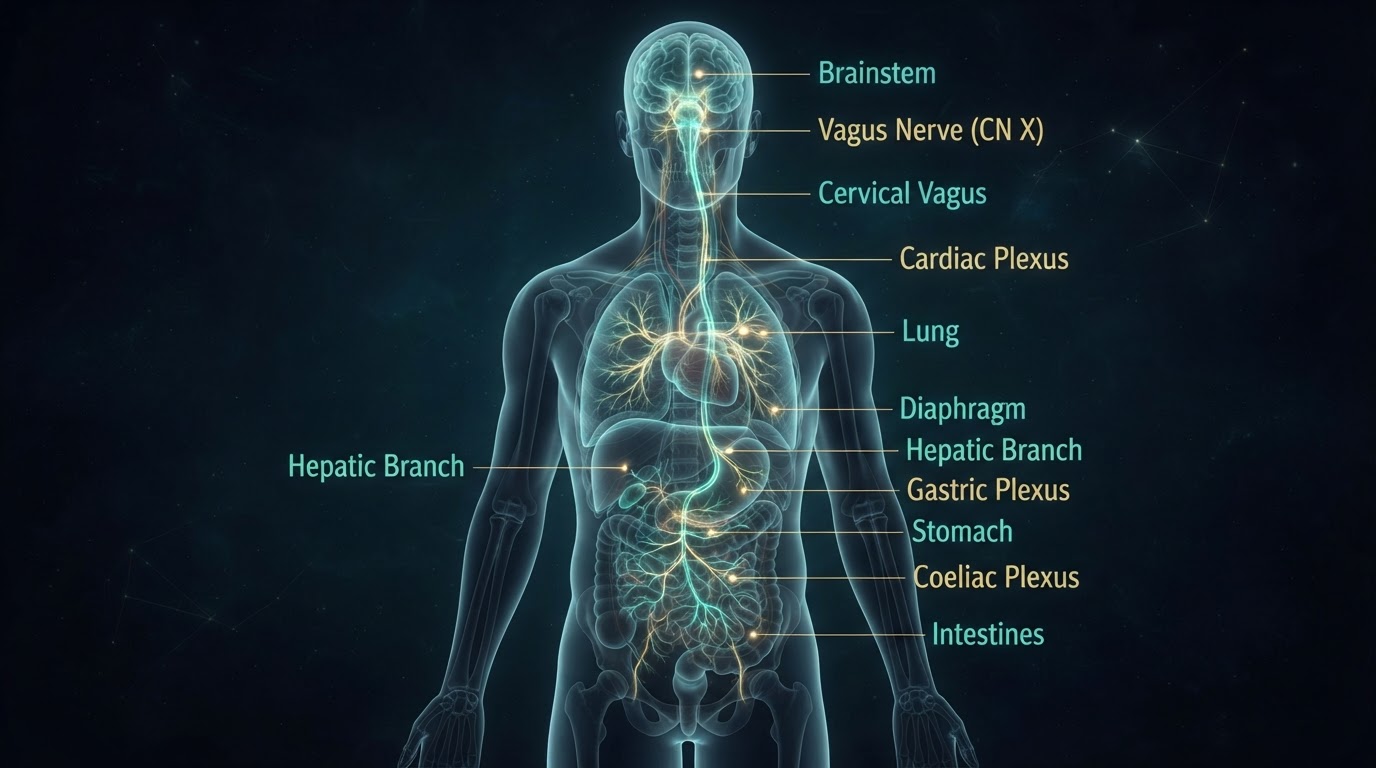
At the center of all of this is the vagus nerve — the longest cranial nerve in the body and the main highway of the parasympathetic nervous system. It governs heart rate, digestion, inflammation, and the body's ability to rest and repair. When the vagus nerve is underactive, the body stays stuck in sympathetic overdrive. When it is toned and responsive, the body can move fluidly between states. This is why so much of nervous system retraining comes down to one simple goal: stimulate and strengthen the vagus nerve.
Breathwork is the most accessible place to start. Slow, deep breathing into the belly directly activates the vagus nerve. Try this: breathe in through your nose for 4 seconds, hold at the top of your inhale for 4 seconds, exhale through your mouth for 5 seconds, hold at the bottom of the exhale for 4 seconds, and repeat. The long exhale is what signals safety — it slows the heart rate and tells the body it can stand down.
Meditation is another powerful tool, and it doesn't have to be intimidating. Your only real job is to bring awareness to what is present — your breathing, the sensations in your body — and let your mind settle. When a stressful thought appears, simply acknowledge it without judgment and imagine it floating on by. The breathing changes that accompany meditation, namely slow deep breathing, also stimulate the vagus nerve to quell stress. If you don't know where to start, begin small — one to five minutes — and consider guided meditations on an app like Headspace or Calm to direct your breath and focus.
Nutrition plays a direct role in vagus nerve function. The nerve relies on adequate choline and B12 to signal properly, and both are precursors to acetylcholine, the neurotransmitter the vagus nerve uses to calm the body. Focus on high amounts of choline (eggs, meat, fish, cruciferous vegetables, kidney beans), high amounts of B12 (clams, salmon, eggs), and plenty of omega-3s (fish, especially sardines and salmon, flaxseed, hemp seed, or a high-quality supplement). These nutrients give the nervous system the raw materials it needs to regulate.
Beyond breath and food, there are dozens of simple, daily practices that directly stimulate the vagus nerve. Yoga, stretching, and walking all encourage gentle parasympathetic activation. Loving-kindness meditation and laughter — even a fake laugh — shift the body toward safety. Music therapy, whether listening, singing, or humming, vibrates the vagus nerve directly through the vocal cords. Sleeping on your right side has been shown to favor vagal tone. Cold-water face immersion triggers the mammalian dive reflex, an immediate vagus nerve stimulant.
Body-based techniques are just as effective. Vagus nerve massage at the base of the head, neck, and shoulders can release stored tension. Gargling with water for 30 seconds to a minute activates the nerve through the throat muscles. Gentle ear massage and light pulling on the ears can relieve TMJ or tension headaches for many — though if this heats your ears and head uncomfortably or triggers a headache, skip it and lean on the other tools instead.
The goal of all of this is not to add more tasks to an already overwhelmed system. It is to send the body a steady, repeated message of safety — through breath, through food, through movement, through sound, through stillness — until that message becomes the new baseline. Healing happens in the parasympathetic state. When the nervous system finally believes it is safe, the body does the rest.
Related conditions: